How Youth Karate in New Berlin Fuels Focus and Academic Growth

The same skills that help your child earn a new belt can also help your child finish homework with less friction.
If you are looking into Youth Karate for your child, you are probably thinking about confidence and self-defense. Those are real benefits, and we care about them. But many parents in New Berlin tell us the day-to-day win they want most is simpler: better focus, better follow-through, and fewer battles over schoolwork.
We see that connection because our classes are built around attention, listening, effort, and calm problem-solving. When your child practices those habits in the dojo, your child can carry them into the classroom, the kitchen table, and the bus ride to school. Youth Karate in New Berlin is not a magic switch, but it can be a practical training ground for the exact behaviors learning requires.
Why focus is a skill, not a personality trait
Focus is often treated like you either have it or you do not. In our experience, focus acts more like a muscle. It gets stronger with repetition, structure, and small, winnable challenges.
In Youth Karate, attention has a purpose. Your child is not just sitting still. Your child is tracking a stance, matching timing to an instructor’s count, noticing distance, and adjusting in real time. That kind of active attention is closer to what school demands than people expect. It is the same “stay with the task” mindset, just practiced through movement.
There is also something quietly helpful about the setting. Class begins and ends with routines. Expectations are clear. Your child knows what comes next, which reduces the mental clutter that can derail concentration. Over time, that steady rhythm teaches a simple message: show up, listen, try, improve.
How Youth Karate supports classroom-ready habits
A lot of academic growth is not about raw intelligence. It is about habits: starting work, sticking with it, handling mistakes, and asking for help appropriately. Our job is to coach those habits in a way kids actually buy into.
Here is what that looks like in practice.
Structured listening and following directions
In class, instructions come in short sequences: stance, guard, step, strike, reset. Your child learns to listen for the whole set, then execute in order. That is basically multi-step direction practice, just more interesting than a worksheet.
We also create natural moments to repeat instructions without shaming anyone. If a student misses a step, we reset, clarify, and run it again. That repetition builds the “I can fix this” response that helps at school when directions feel overwhelming.
Working memory and sequencing
Many karate drills require your child to hold a pattern in mind while moving. That trains working memory, which is a key ingredient in reading comprehension and math. When your child remembers the next move in a combination, your child is practicing the same mental skill used to remember the next step in a long division problem or the next paragraph’s main idea.
Emotional regulation under pressure
Tests, presentations, and group projects can spike stress. In Youth Martial Arts in New Berlin, we put students in controlled, age-appropriate challenges: performing in front of peers, learning a new skill that feels awkward, or trying again after a miss.
We coach breathing, posture, and composure. It is not therapy, and we keep it grounded. But students learn that nerves are not a stop sign. That lesson matters when a child has to read out loud, raise a hand, or walk into a quiz.
The belt system and why it matters for academics
Kids understand progress when progress is visible. The belt system gives your child a clear pathway: learn skills, practice consistently, demonstrate readiness, level up. That is a framework school does not always make obvious.
When your child works toward a new belt, your child experiences:
• Long-term goal setting with short-term checkpoints, so effort feels connected to outcomes
• Consistent practice habits, because improvement comes from repetition, not “cramming”
• Feedback that is specific and actionable, like adjusting stance width or hand position
• Healthy performance pressure in a supportive setting, which builds confidence without arrogance
• Pride earned through effort, which often spills over into school motivation
We also like how belts reward persistence, not perfection. That is important for students who get stuck in all-or-nothing thinking. If your child believes “I have to be naturally good at this,” a few tough homework nights can feel like failure. Karate reframes it: you can be new at something and still get better.
A typical student journey: from scattered energy to steady effort
Many kids walk in with plenty of energy but not much control. That is normal. The early weeks of Youth Karate often look like this: your child is excited, a little distractible, and eager to move fast.
We do not try to squash that spark. We shape it. Your child learns where to stand, when to speak, how to respond to cues, and how to reset after a mistake. Instructors correct posture and technique, but we also coach behavior in a calm, consistent way. Kids tend to relax when the boundaries are clear.
After a couple months, many families notice small shifts that matter. Mornings can feel smoother. Homework starts with less arguing. Your child might still be a kid, of course, but your child has practiced self-control in a place that makes it feel achievable.
Focus tools your child can use outside the dojo
We want you to see benefits beyond class, so we teach skills that transfer. Here are a few practical tools we reinforce, and you can use them at home without turning your living room into a training hall.
1. The reset breath: One slow breath before starting a task, like opening a book or beginning a worksheet
2. One instruction at a time: Break directions into the next single action, then the next
3. The two-minute start: Commit to beginning for just two minutes to reduce resistance
4. The “show me” check: Have your child explain the assignment back in their own words
5. Finish with a clean stop: Put materials away and close the loop, so tasks feel complete
These are small, but they build momentum. And momentum is often what struggling students are missing.
How our classes build attention through movement
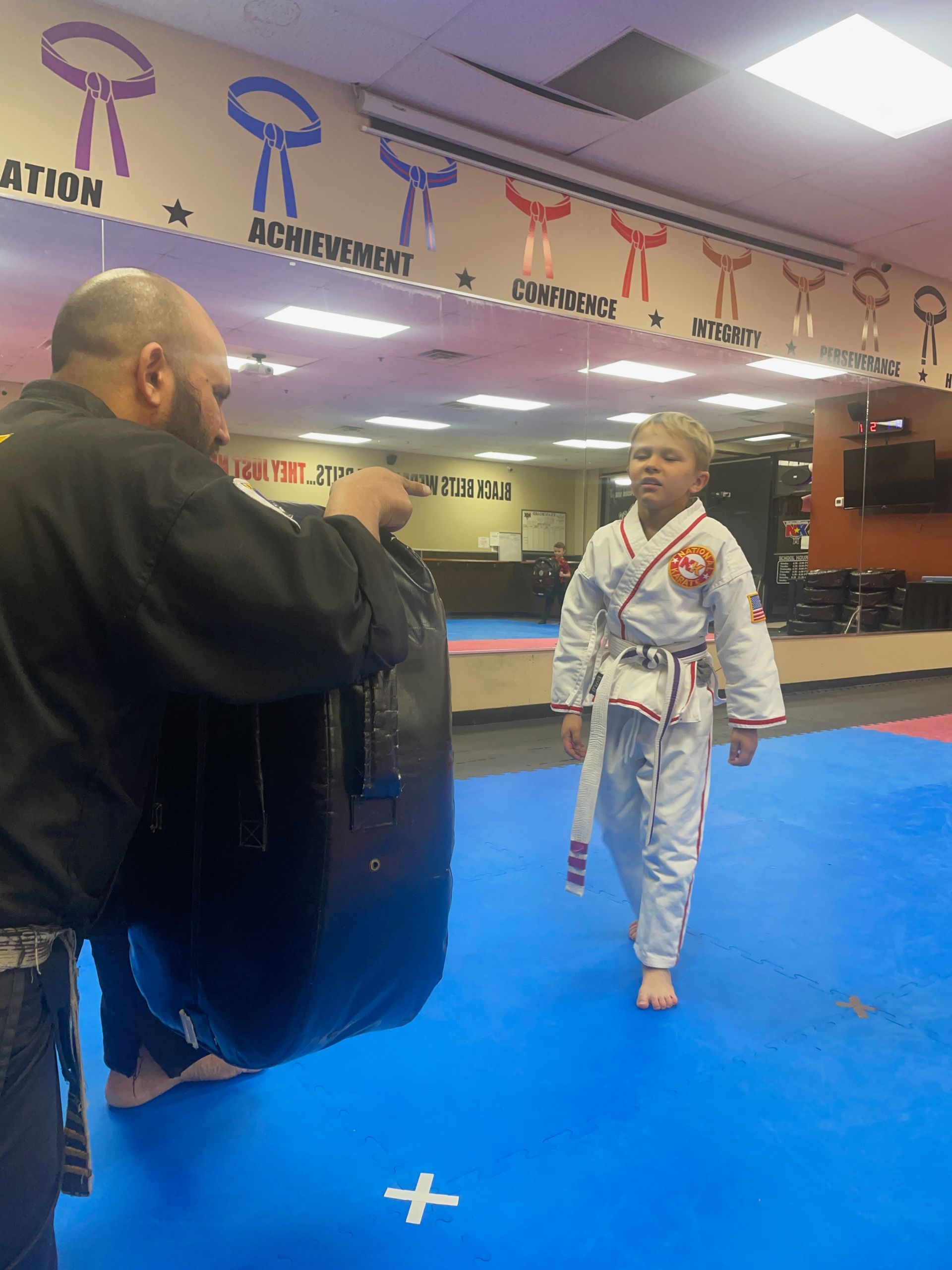
Kids do not always learn best by sitting still. Movement gives many students an on-ramp to focus. In our Youth Karate in New Berlin classes, we use drills that require attention without feeling like school.
For example, line drills teach students to respond to counts and cues while staying aware of spacing. Partner drills teach timing and respect for boundaries. Forms and combinations teach sequencing. Even warm-ups teach pacing, because students learn to match effort to the moment instead of going full speed all the time.
We also keep safety and control at the center. A focused student is a safe student. The requirement to control technique builds impulse control in a concrete way. Your child cannot just “let it fly.” Your child has to choose accuracy, balance, and control.
Confidence that supports school, without turning into attitude
Confidence gets talked about a lot, but we define it in a grounded way. Real confidence is not loud. It is the quiet belief that you can handle a hard thing if you keep working.
When your child trains consistently, your child gets proof. Proof that effort matters. Proof that mistakes are part of learning. Proof that your child can be coached and improve. Those experiences make it easier to face school challenges like a difficult reading assignment or a confusing math unit.
We also emphasize respect: for instructors, classmates, and the learning process. That respectful mindset supports classroom behavior and helps students take feedback without spiraling into frustration.
What parents in New Berlin should look for in Youth Karate
If your main goal is focus and academic growth, look for a program that does not rush kids through flashy moves. You want structure, consistency, and instructors who can keep a class both energetic and orderly.
In our program, we keep classes age-appropriate and skill-appropriate. We teach kids how to stand, how to listen, how to move with control, and how to progress step by step. We also encourage steady attendance because that is where the results show up.
If you are wondering about membership options or how often your child should train, the best answer depends on your schedule and your child’s temperament. We can help you choose a pace that feels realistic, because a consistent plan beats an intense plan that falls apart after three weeks.
Take the Next Step
Building stronger focus is not about adding more pressure to your child’s life. It is about giving your child a place to practice attention, discipline, and resilience in a way that feels engaging. That is exactly what we aim to deliver every day on the mats.
When you are ready, Wisconsin National Karate Kickboxing & Krav Maga can help you plug Youth Karate into your family’s routine in a way that supports school success and personal growth. If you want to start simple, we can begin with a first class and a conversation about your goals.
Help your child build confidence, discipline, and focus by enrolling them in youth martial arts classes at Wisconsin National Karate.